Reflections from the final evaluation of an Integrated Village Development Programme run by Yayasan Mitra Tani Mandiri with Caritas Australia and DFAT-ANCP, February 2026. Photographs by Obiet Wicaksono. Individual community members are identified by role only, in line with the research-participant protection protocol. Both authors are contributors to Geni Lintang.
There is a particular humility that comes from arriving in a place in order to measure it.
In February I spent ten days across twenty-four villages in the rainfed savannas of West Timor, in the districts of Belu, Malaka, and Timor Tengah Selatan, as the lead evaluator of a five-year village development programme. My task was precise: to judge it against the standard criteria, relevance, effectiveness, efficiency, impact, sustainability. I came with frameworks. I left with something the frameworks did not have a column for.
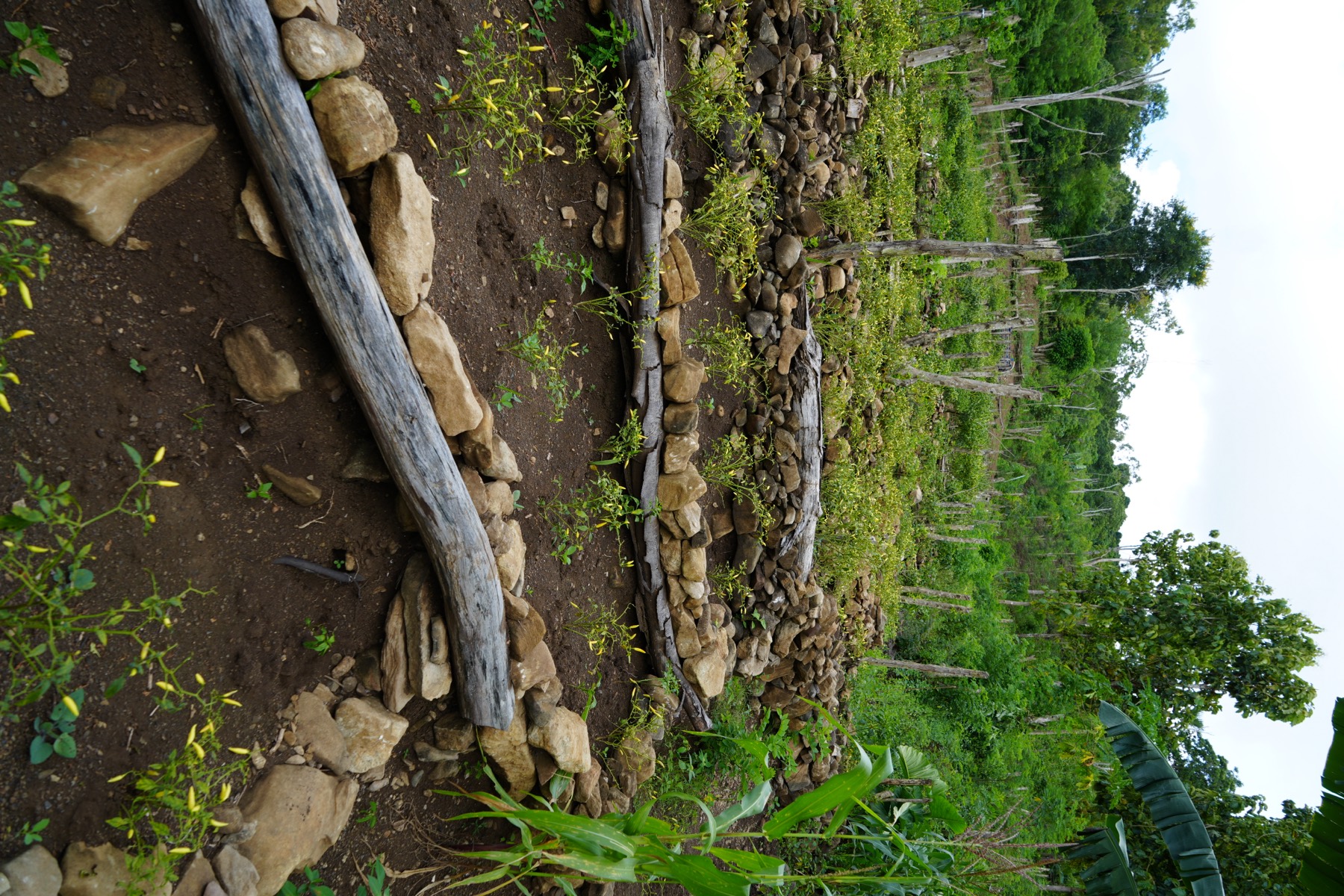
Stone-and-timber terracing on a hillside garden, built and rebuilt by the households that farm it.
The programme, run by a local foundation that has worked in these hills for more than three decades, rests on a simple and almost subversive premise: that underprivileged communities are not empty vessels waiting to be filled, but holders of assets, of land, kinship, faith, knowledge, and labour, that the right kind of accompaniment can release. In the language of the sector this is called asset-based community development. A woman who leads a savings group put it more plainly: "Kita mulai dengan apa yang kita punya, dan bekerja dengan apa yang kita tahu." We start with what we have, and work with what we know.
I met a farmer in Malaka, a woman who has been deaf since birth, who in a single dry season produced eight hundred kilograms of compost and grew enough to keep her children in school. Her productivity was not created by the programme. It existed before anyone arrived. What the programme did was narrower, and more honest, than the word "empowerment" usually admits: it built the financial infrastructure and offered the technical accompaniment that let an existing capacity become an income. The asset was always there.
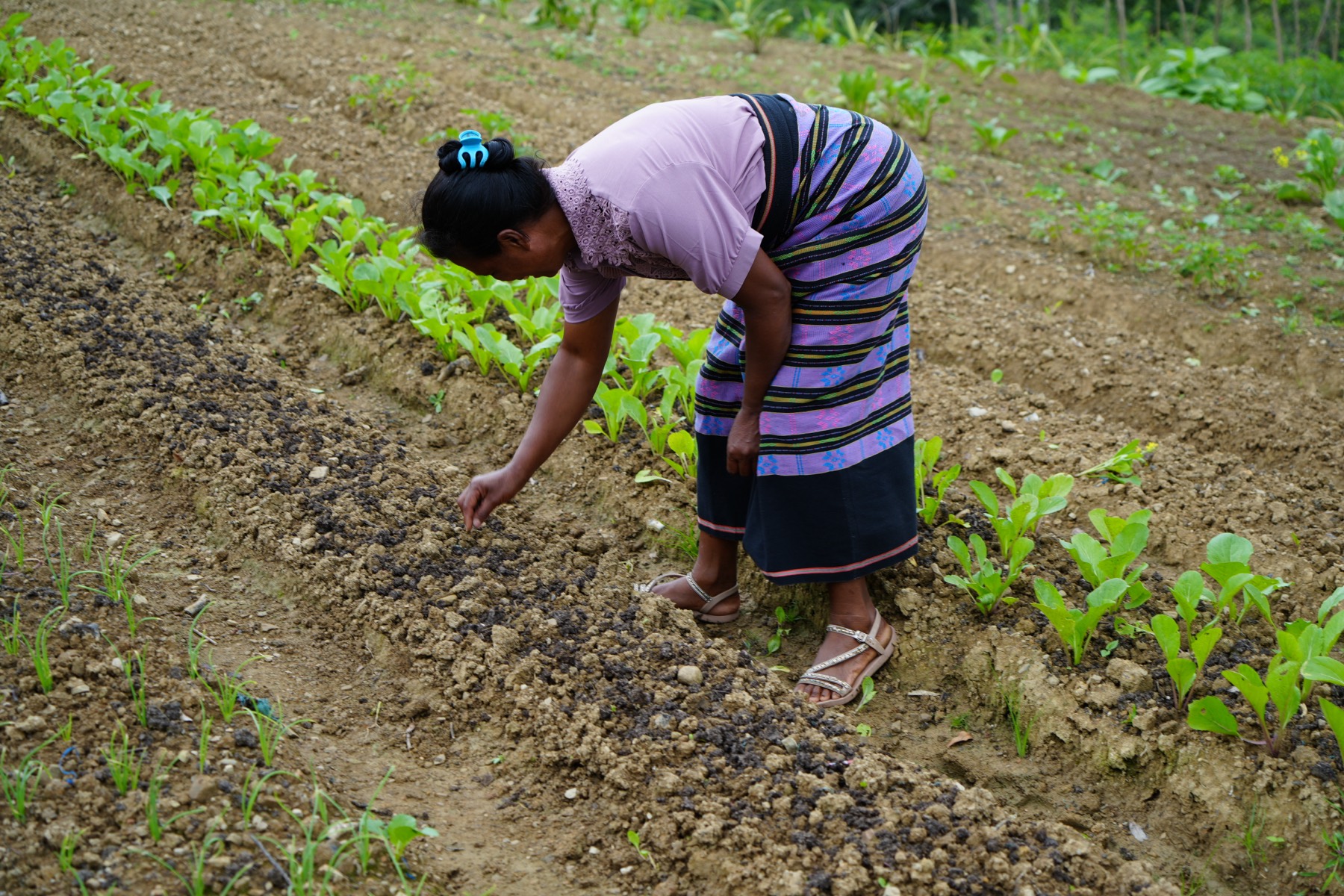
A mama setting seedlings into prepared rows. This is the labour no extension record counts, and the customary council does.
This was the quiet correction the fieldwork kept making to my assumptions. We tend to describe development as delivery, something carried in from outside to a place that lacks it. But the most durable things I saw were not delivered. They were accompanied.
Consider the savings groups. Across the network they now hold on the order of two and a half billion rupiah, and almost none of it came from the programme budget. It was saved, a little at a time, by members, most of them women. The programme funded the training, not the capital. For the enterprising, these groups finance livestock, gardens, and small shops. For the most vulnerable they are something else entirely. A widow in a highland village explained why she had borrowed: "Saya seorang janda, jadi saya pinjam dari UBSP untuk kelola tanah dan tanam hasil, akhirnya saya juga bisa hidup sampai saat ini." As a widow, I borrowed to work the land and grow a harvest, and in the end I can still live to this day. She did not describe a percentage. She described being alive. For those with no second income to fall back on, a community savings group is not enterprise development. It is social insurance, owned by the people it insures, and it had quietly displaced the daily moneylenders whose rigid repayments, a pastor's wife told me, used to cause real anguish.
What makes any of this possible is not a technique. It is trust, and trust here is built in a specific, unglamorous way: by staying. The foundation's facilitators do not visit. They live in the villages, for years. They sit at funerals, offer sirih pinang at customary gatherings, and are folded into the social fabric until, as one of them said, families telephone to ask after his health when he is away. A sub-district head who has watched the organisation work for fifteen years told me the difference without sentiment: government programmes create motivation through visits; presence creates transformation. You cannot parachute trust. You can only accumulate it, slowly, by being there when nothing is being measured.
Presence also lets a programme see what a survey cannot. In one village a customary elder grieved the slow disappearance of the old ecological law, the prohibitions that once governed when a forest could be entered and what could be cut, enforced by fines paid in livestock and traditional cloth. He tied their erosion to a wider unravelling, and no five-year programme reverses that. Yet I also saw the forest still doing economic work that no ledger records: the dye plants for the weavers, the hardwood charcoal for the forge, the fodder and fuel of the permanent gardens. The fabric is still one fabric. Food, water, livestock, finance, forest, and faith are not separate sectors here. They are a single weave, and the communities have always known it, even where the policy dashboards do not.
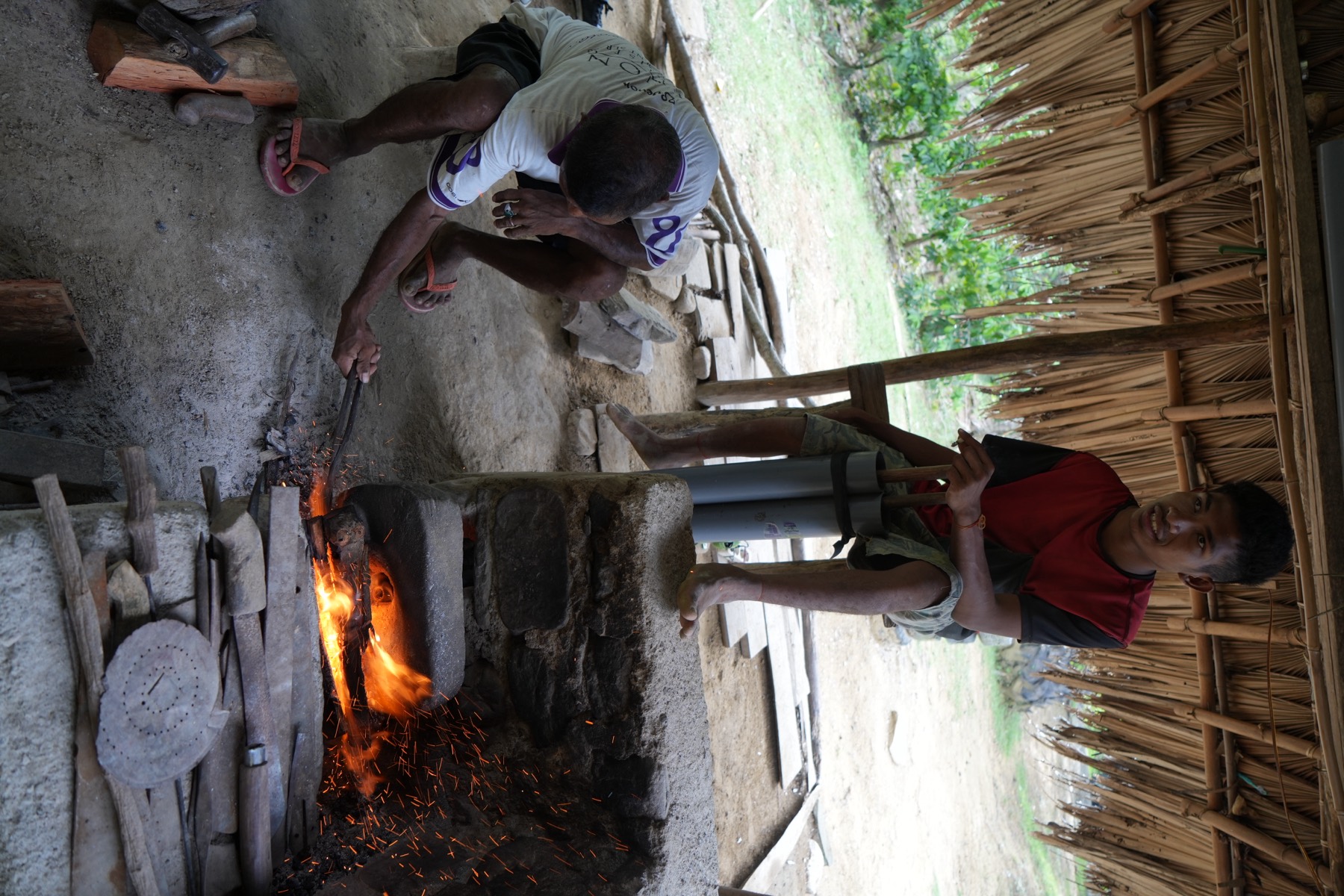
A village forge. Blades for the gardens are hand-forged here, fired with charcoal from the same forest the customary prohibitions once protected.
I also want to be honest about time, because time is the quiet protagonist of this kind of work. Real change in a place this long underserved is not the work of a single funding cycle. The institutions I saw, the savings groups, the cadres, the gardens, were genuine, but in many villages still young; and the youngest were not the weakest, only the newest. One woman told me she had farmed her whole life before any accompaniment reached her. It was not a complaint. It was a measure of how long the need had been waiting, and how much patience the work deserves.
There is a temptation, when the numbers look good, to declare a thing finished. The savings have grown, the harvests have improved, most of the targets are met. But the evaluation taught me that the most decisive variable is the one imposed from outside: time. Five years is enough to plant something. It is rarely enough to know whether it will hold. The communities that were most ready were those accompanied the longest, eight years and more. The newer ones were not less capable; they had simply been given less time. That is less a verdict than a reminder: this is patient work, better served by graduated, multi-phase support than by any single sprint.

Yarn dyed with colours gathered from the forest, drying before the loom. Some things keep their value precisely because they take time.
I went to East Nusa Tenggara to measure a programme. What I am left with is smaller, and harder, than a rating. Development at its best does not deliver; it accompanies. It begins with what a community already holds, it moves at the speed of trust, and it has the humility to stay a little longer than the funding cycle finds convenient. The asset was always there. Our part, if we are honest about it, is mostly not to leave before it can stand on its own.